If you’ve spent any time in the precision casting industry, you know how much rides on every tiny detail of the final part. A single microscopic inclusion, a crack, or a poorly controlled grain structure can derail weeks of work, scrap thousands of dollars in raw materials, and delay a product launch that’s months in the making. For years, foundries have relied on a handful of filtration solutions to clean molten metal before it’s poured into molds, but one material has quietly shifted the conversation in recent years: silicon carbide (SiC) ceramic foam filters. As a supplier that’s worked closely with precision casting foundries for over a decade, I get asked this question at least once a week: Can SiC ceramic foam filters actually be used in precision casting? The short answer is yes—but it’s not just a yes or no. It’s a nuanced, context-dependent yes that comes with specific advantages, limitations, and best practices that many foundries still haven’t fully leveraged. Today, I want to break that down, from the unique properties of SiC filters that make them ideal for precision work to the real-world results I’ve seen with clients, and what you need to know before adopting this technology for your own casting processes. Silicon Carbide Ceramic Foam Filter
First, let’s ground this in what precision casting actually demands. Unlike sand casting, which is used for large, low-stress parts like engine blocks, precision casting (which includes investment casting, lost-wax casting, and Die casting for complex, high-tolerance components) requires parts with dimensional tolerances as tight as ±0.05 millimeters, smooth surface finishes, and zero defects that could compromise performance. These parts often go into aerospace, medical devices, automotive turbochargers, and industrial valves—applications where failure isn’t an option. That means the molten metal you pour has to be nearly free of inclusions: tiny bits of sand, refractory material, oxide, or slag that get picked up during melting, transfer, and pouring. Even a single inclusion in a critical component like a turbine blade can lead to catastrophic failure mid-flight, or a hip implant that needs revision surgery.
Traditional filters for precision casting have included materials like alumina (Al₂O₃) and zirconia (ZrO₂), along with fiberglass and paper filters for smaller runs. But these materials have gaps that hold them back in precision applications. Alumina filters, for example, work well for high-temperature metals like steel, but they’re brittle and can shed small particles when exposed to turbulent molten metal flow, which introduces new inclusions. Zirconia filters are more durable, but they’re expensive, and their high density means they can settle in the bottom of the pouring basin, leaving the top layer of metal unfiltered. Paper and fiberglass filters only work for low-temperature non-ferrous metals like aluminum, and they burn out quickly in high-temperature steel or superalloy casting, leaving behind residue.
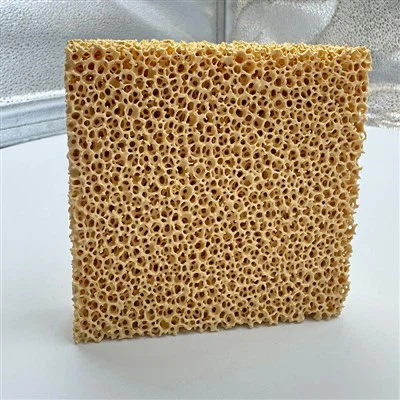
This is where SiC ceramic foam filters come in, and their core properties make them a game-changer for precision casting. First, SiC has an extremely high melting point: around 2,730°C (4,946°F), which is higher than alumina (2,072°C) and almost double the melting point of most common casting metals. That means it doesn’t soften or break down when exposed to the superheated molten metals used in precision casting—think carbon steel, stainless steel, nickel-based superalloys, and titanium alloys. Second, SiC is chemically inert with most molten metals and their oxides, especially at high temperatures. It doesn’t react to form intermetallic compounds that could contaminate the metal, a problem that plagues alumina filters when working with reactive metals like titanium. Third, the porous structure of ceramic foam filters—made by coating a polyurethane foam scaffold with SiC slurry, then burning away the foam to leave a network of uniform, interconnected pores—creates a large surface area for capturing inclusions without causing excessive turbulence. Turbulence is a big no-no in precision casting: it introduces air bubbles, which lead to porosity, and splashes that can create defects in the mold cavity.
But here’s the thing: not all SiC ceramic foam filters are created equal for precision casting. When I started in this business 12 years ago, many low-cost suppliers were selling general-purpose SiC filters made for sand casting, where pore size is larger and filtration efficiency is less critical. Those filters don’t work for precision work. Precision casting requires filters with tightly controlled pore sizes, usually between 10 and 40 pores per inch (PPI), depending on the metal and part complexity. For small, intricate investment castings for medical implants, 30 to 40 PPI filters are ideal, because they capture even tiny inclusions (as small as 20 microns, or 0.02 millimeters) without restricting metal flow so much that the casting doesn’t fill properly. For larger precision parts like turbocharger impellers, 15 to 20 PPI filters strike the right balance between flow rate and filtration efficiency. The uniformity of the pores is equally important. A filter with uneven pore sizes—some too small, some too large—will either slow down the metal so much that it cools prematurely (leading to misruns) or fail to catch small inclusions, defeating the entire purpose of filtration.
Over the years, I’ve worked with more than 70 precision casting foundries across North America and Europe to test SiC filters, and the results have been consistently impressive—when the right filter is chosen and installed correctly. Let me share a specific example: a medical device client that produces orthopedic implants, specifically titanium femoral stems. Before switching to custom SiC ceramic foam filters, they had a 12% scrap rate due to surface inclusions, which required polishing each part by hand and sometimes led to full part rejection. They were using alumina filters, but titanium’s reactivity caused the alumina to break down, releasing aluminum particles that showed up as defects on the implant surface. We recommended a 30 PPI SiC filter designed specifically for titanium casting, with a coated outer rim to prevent edge leakage (a common problem that many foundries miss: if the filter doesn’t fit tightly against the pouring basin, unfiltered metal can flow around the sides). Within three months, their inclusion-related scrap rate dropped to 2.8%, a 77% reduction. They also reduced their polishing time by 60%, cutting labor costs by over $120,000 a year. That’s the kind of impact SiC filters can have on precision casting, but it’s not just about the filter itself—it’s about application.
Another common question I get is whether SiC filters work for all types of precision casting. The answer here is mostly yes, but there are edge cases to consider. Investment casting, the process used for the most complex precision parts, is where SiC filters shine. The controlled pore size and high heat resistance make them perfect for the superalloy and titanium melts common in aerospace turbine blades and medical implants. They also work well for die casting, where molten metal is forced under high pressure into a mold—here, the key is choosing a filter that can withstand the high flow rates without cracking. For centrifugal casting, which is used for cylindrical precision parts like valve bodies, SiC filters capture inclusions while the centrifugal force separates lighter slag from the heavier metal. Where SiC filters are less ideal? For very low-temperature, non-ferrous precision casting, like small aluminum parts for electronics. In those cases, cheaper alumina or even paper filters work just fine, and SiC’s high melting point is overkill—though I’ve had clients test SiC for aluminum and found it reduced porosity by 15% even in those applications, so it’s worth a test run if part quality is a top priority.
The biggest mistake I see foundries making when adopting SiC filters is choosing the wrong pore size and not optimizing their installation. Let’s talk about pore size first. If you use a 10 PPI filter for a small, intricate investment casting, the large pores won’t catch the tiny inclusions, leading to defects. Use a 40 PPI filter for a large turbine blade, and the metal flows too slowly, cooling before it reaches the far ends of the mold, leading to misruns and incomplete parts. It’s all about matching the filter to the part. For example, a turbocharger impeller, which is about 12 inches in diameter and has thin, complex blades, works best with 15 PPI SiC filters. The larger pores let the metal flow fast enough to fill the thin blades, while still catching inclusions as small as 50 microns—small enough to prevent performance issues in the final part. For a 2-inch medical implant with tight surface finish requirements, 35 PPI is the sweet spot.
Installation is almost as important as the filter itself. I can’t tell you how many times I’ve visited a foundry where a SiC filter was placed loosely in the pouring basin, with gaps between the filter and the basin wall. Unfiltered metal flows around those gaps, and all the benefits of the filter go out the window. We always recommend using a filter with a compatible rim, either coated with a refractory material that seals against the basin or designed to snap into place for a tight fit. Another installation tip: preheat the filter before use. SiC filters can crack if they’re exposed to rapid temperature changes when hot molten metal hits a cold filter. A 15- to 20-minute preheat in a small furnace, or even by placing it next to the pouring basin before use, prevents thermal shock and extends the filter’s lifespan, while also helping to maintain a consistent metal temperature during pouring.
Of course, no technology is perfect, and SiC ceramic foam filters do have limitations for precision casting. The biggest one is cost: high-quality precision-grade SiC filters are more expensive than general-purpose alumina or zirconia filters. But when you factor in the reduction in scrap, lower labor costs, and fewer post-processing steps, the ROI is almost always positive. That medical implant client I mentioned earlier didn’t save money by cutting material costs—they saved over $200,000 a year in scrap and labor by switching to SiC filters, even though each filter cost twice as much as the alumina ones they were using. Another limitation: SiC filters are heavier than some other filter materials, so in processes where weight is a critical factor (like small, automated pouring systems), you have to adjust the design of the pouring basin to accommodate the filter’s weight. But for most manual and semi-automated precision casting lines, this is a negligible issue.
I also want to address a common misconception that I hear all the time: that ceramic foam filters add enough resistance to metal flow to reduce casting yield. That’s only true if you choose the wrong filter. When sized correctly, SiC filters actually improve yield because they reduce scrap from defects, not because they restrict flow. In fact, many foundries report higher overall metal yield because they can pour metal at a slightly lower temperature (since the filter helps remove inclusions at lower temperatures, reducing the chance of defects from overheating) and use less post-processing to fix flawed parts.
Looking ahead, I think SiC ceramic foam filters will become the standard for precision casting in the next 5 to 10 years. As industries like aerospace and medical devices continue to demand tighter tolerances and higher part reliability, the limitations of older filtration materials will become more apparent. Titanium and nickel-based superalloys are growing in use for precision parts, and those metals are highly reactive and prone to inclusions—making SiC’s chemical inertness and high heat resistance even more valuable. I’ve already worked with three major aerospace manufacturers that have qualified SiC filters for use in their turbine blade casting processes, and more are in qualification testing every quarter.
If you’re considering whether to switch to SiC ceramic foam filters for your precision casting operations, my advice is to test, don’t guess. Most suppliers (including ours) offer custom-sized filters and small sample packs for foundries to test in their own lines for 30 to 90 days. Run a side-by-side test: pour half your castings with your current filter, half with a test SiC filter, and track scrap rates, post-processing time, and part quality. I’ve yet to see a foundry that ran this test and didn’t choose to switch long-term. At the end of the day, precision casting is all about control—controlling defects, controlling material quality, controlling costs. SiC filters give you that control, by providing consistent, reliable filtration that meets the exacting standards of the precision casting industry.

If you’re ready to take the next step to reduce defects, lower costs, and improve the quality of your precision cast parts, don’t hesitate to reach out to discuss your specific application and sample options. Together, we can find the right SiC ceramic foam filter solution for your needs, tailored to your part size, metal type, and casting process.
Zirconia Ceramic Foam Filter References
- Campbell, J. (2015). Castings, 2nd ed. Butterworth-Heinemann.
- Tiryakioglu, M., & Campbell, J. (2007). Filtration of molten metals: A review. International Journal of Cast Metals Research, 20(3), 129-140.
- Zhang, Y., Li, J., & Wang, H. (2020). Performance of silicon carbide ceramic foam filters for precision casting of superalloys. Journal of Materials Processing Technology, 282, 116682.
- American Foundry Society. (2019). Precision Casting Process Standards and Practices. AFS Press.
Shanxi Dingtai Yinrui Filter Manufacturing Co., Ltd.
As one of the most professional silicon carbide ceramic foam filter manufacturers and suppliers in China, we’re featured by quality products and good service. Please feel free to buy high-grade silicon carbide ceramic foam filter made in China here from our factory. Contact us for more details.
Address: Plant 1-2, No.3 Xuhu Business and Trade Industrial Park, Houma Economic Development Zone, Linfen, Shanxi, China
E-mail: tina@dtcastingfilters.com
WebSite: https://www.dingtaifilter.com/
