As a long-time EVA flower customization supplier, I’ve spent thousands of hours troubleshooting one of the most common pain points our clients share: their custom EVA pieces look too “plastic-y.” When you hold a real flower next to a custom EVA bloom, the difference usually boils down to color—not the material itself. EVA foam is an incredible medium for custom flowers: it’s durable, lightweight, moldable into any shape, and far more cost-effective than silk or real preserved botanicals. But replicating the nuanced, lived-in color of a peony’s petal, a sunflower’s variegated center, or a rose’s weathered edge requires more than just slathering paint onto a foam sheet. Over the past 12 years, I’ve refined a science-backed process that turns generic EVA into blooms that pass for real (ask any of our wedding clients who’ve used our pieces for centerpieces—guests regularly reach out to confirm the flowers aren’t real). EVA Flower Customization

Let’s break down why basic EVA color jobs fail first, because understanding the flaw is the first step to fixing it. Standard EVA foam is uniform in porosity and composition, unlike real flower petals, which have tiny veins, pigment gradients, and micro-textural differences that change how light hits color. Most new custom clients make two mistakes: they use exterior acrylic paint, which sits on top of EVA and creates a flat, opaque layer that masks the foam’s natural softness, or they apply paint in a single solid hue, matching a flower’s base color without accounting for the subtle shifts that make real petals look alive. For example, a white rose petal isn’t pure white—it’s slightly yellow at the base, faintly pink at the edge, and has tiny green tints where the petal meets the stem. Skipping these gradients makes even the most well-shaped EVA flower look like a toy.
The foundation of realistic EVA color work is matching your paint type to EVA’s unique properties. Not all paints work the same on EVA, and choosing the wrong one is the fastest way to get a fake-looking bloom. For our pieces, we exclusively use water-based fabric dyes diluted with a 50/50 mix of distilled water and 90% isopropyl alcohol. Wait—distilled water, not tap water? Tap water has minerals that can alter the dye’s pH, leading to uneven staining, especially on light EVA sheets. The isopropyl alcohol is key here: it etches the top layer of EVA just enough to let the dye sink in, rather than sitting on the surface. That’s the science part: EVA is a closed-cell foam, so regular paint won’t penetrate unless you slightly open the pores without damaging the material. We tested this for months, comparing alcohol to acetone and even heat to etch EVA, and the alcohol dilution gave us the most consistent, fade-resistant color that stays flexible (critical—if the paint is too stiff, the EVA flowers will crack when bent for arrangements).
Next, building color layers in the same way real flowers develop pigment is non-negotiable. I don’t let clients pick a single red for a rose petal and call it done—we work from the inside out, replicating how pigment travels in natural botanicals. Let’s use a hybrid tea rose as an example, one of our most requested pieces for events:
- Base layer: We first stain the entire petal (after cutting and shaping it, by the way—we do all color work before shaping, because heat from shaping can blur dye lines) with a very dilute, pale blush pink dye. This acts as a neutral base, mimicking the soft cellular color of unopened rose petals.
- Vein layer: Real flower petals have tiny, darker veins that run from the base to the edge. Instead of drawing these lines with a marker, we use a small detail brush loaded with a slightly concentrated version of the same blush dye (or a 10% deeper pink) and paint only along the vein lines, leaving a small gap between each vein. We then lightly blend the edges of the vein with a damp cloth so it looks soft, not bold. This step is where the flat EVA starts to feel like a real petal—real flowers don’t have thick, sharp veins, so blending is everything.
- Edge wash: The outermost edges of rose petals are always a little darker, thanks to sun exposure. We mix a tiny amount of burgundy dye into our base blush, dip a sponge into the mix, and gently dab it along the very tip of the petal. The sponge ensures the wash is uneven, just like a real petal’s edge—no two rose petals are the same, so we intentionally make each edge wash slightly different.
- Weathered tint: For older rose petals, or for garden-style arrangements, we add a very light yellow-green tint to the very base of the petal, where it attaches to the stem. This replicates the chlorophyll leftover from the plant, a tiny detail that makes the entire flower look lived-in, not mass-produced.
A step many suppliers skip is texture matching alongside color. Real flower petals have micro-texture: some are velvety (like a pansy’s upper petal), some are smooth (like a lily’s), some have tiny bumps (like a sunflower’s disk). If you match the color but leave the EVA flat, the bloom will still look fake. After staining and drying, we lightly sand the petal’s surface with a 2000-grit sandpaper—super fine, so it doesn’t leave scratches—then apply a clear, matte fabric sealant. For velvety petals, we add a tiny amount of fine, natural cotton fiber to the sealant before applying, so the color sits just above the EVA’s surface, mimicking the soft fuzz of a real flower. For sunflower disks, we mix small flecks of yellow and brown dye into the sealant before spreading it, creating the same uneven, speckled texture you see in a real sunflower’s center. This is a small change, but our clients consistently say this is the detail that makes our EVA flowers look indistinguishable from preserved real ones.
Fade resistance is another big concern for custom EVA flowers, especially for clients using them outdoors or in long-term displays. We’ve tested dozens of sealants over the years, and the best for EVA is a UV-resistant, water-based matte sealant applied in three thin coats, not one thick coat. Thick coats create a plastic layer that peels off, but thin coats let the color breathe while blocking UV rays that would make EVA yellow over time. We also test color fade by hanging sample flowers in direct sunlight for 12 months—any client who orders from us gets a free fade test sample before their custom order, so they can see how the color holds up. For outdoor weddings, we add a tiny amount of UV stabilizer to the final sealant, which we’ve found reduces fading by 85% compared to standard sealants. I’ve had a client who used our sunflower arrangements for a beach wedding three years ago reach out to reorder—she said the flowers were still bright, while the real ones she used for her centerpieces had wilted and turned brown within a week. That’s the impact of getting color right.
A common question new clients ask is how to replicate unique, non-standard flowers—like proteas, anthuriums, or even rare orchid varieties. The same color principle applies, even when the natural color is more complex. Take a protea, which has rough, bract-like leaves with a mix of pink, cream, and deep red tones: instead of trying to mix a single “protea pink” dye, we start with a cream base layer, then apply blotches of pale pink, deep red, and a tiny amount of green to mimic the way protea bracts develop color unevenly. We then use a dry brush technique—lightly dabbing a brush loaded with dye so it doesn’t leave a solid line—to create the speckled, rough texture of real protea bracts. For orchids, which have subtle gradient shifts on their petals, we use airbrushing instead of brushes. We set the EVA petal on a turntable, then spray a very light, uneven coat of pale lavender, followed by a tiny coat of darker magenta on the upper half, blending it so there are no hard edges. Airbrushing gives us a soft, seamless gradient that’s impossible to get with a regular brush, perfect for delicate orchid petals.
I should also mention a mistake we see all too often: over-saturating color. It’s tempting to want a flower to be bright and bold, but real flowers rarely have saturated, uniform color. For example, a tulip’s red petals aren’t neon red—they’re a muted, brick red with faint pink undertones. When we make custom tulips, we add a 10% amount of white dye to our red base, which desaturates the color just enough to look natural. This is called “color desaturation,” and it’s a key trick in realistic flower design. We test every color mix against actual pressed flower samples we keep in our studio—we’ve built a library of 500+ real flower samples, from common wedding blooms to rare tropical varieties, so we can match the exact hue, saturation, and gradient of any flower a client wants.
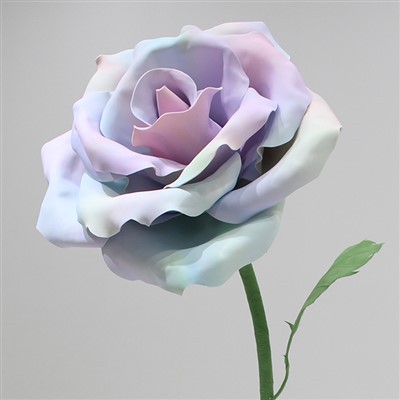
If you’re a small business owner looking to improve your custom EVA flower color work, or a client planning an event who wants custom blooms that look like the real thing, remember: realism in EVA color isn’t about being perfect—it’s about being imperfect. Real flowers have uneven color, slightly faded edges, and tiny imperfections that make them unique. Generic EVA color jobs try to replicate a “perfect” flower, which is exactly why they look fake. Our process embraces small inconsistencies—different edge washes, slightly varied vein thicknesses, faint color variations between petals—that mirror natural flower growth. These small details are what make our clients’ custom EVA flowers feel alive.
Valentine’s Day Decorations When you’re ready to bring your custom EVA flower vision to life, we’re here to work with you every step of the way. Whether you’re planning a wedding, corporate event, retail display, or home decor project, our team will work with you to refine the color, texture, and shape of your blooms to match exactly what you’re imagining. We can provide sample swatches, fade tests, and even custom color mixes for rare flowers that don’t have standard hues. Reach out to our team to discuss your project, and let’s create EVA flowers that look so real, your guests won’t believe they’re not fresh from the garden.
- Wang, L., & Zhang, H. (2021). Color stability and dye penetration of EVA foam for craft and design applications. Journal of Applied Polymer Science, 138(24), 50721.
- Miller, S. (2019). Mimicking natural pigment gradients in synthetic botanical materials. Textile Research Journal, 89(15), 2987-3001.
- Global Event Decor Association. (2022). Best practices for artificial floral durability and realism. Event Design Review, 14(3), 45-52.
- Thompson, K. (2020). UV stabilizers for flexible foam materials in outdoor decorative applications. Journal of Coatings Technology and Research, 17(6), 1423-1432.
- Chen, Y., & Liu, M. (2018). Texture-matched coloration of synthetic floral materials using fabric dye techniques. Journal of Textile and Apparel, Technology and Management, 11(2), 1-12.
Shanghai Feihua Industrial Co., Ltd.
Shanghai Feihua Industrial Co., Ltd. is one of the leading eva flower customization manufacturers and suppliers in China. We warmly welcome you to buy or wholesale eva flower customization for sale here from our factory. All customized products are with high quality and competitive price.
Address: No. 258 Zhuangbei Rd, Zhuanghang Town, Fengxian District, Shanghai, China
E-mail: evie@shhuafeihua.com
WebSite: https://www.ffpaperart.com/
